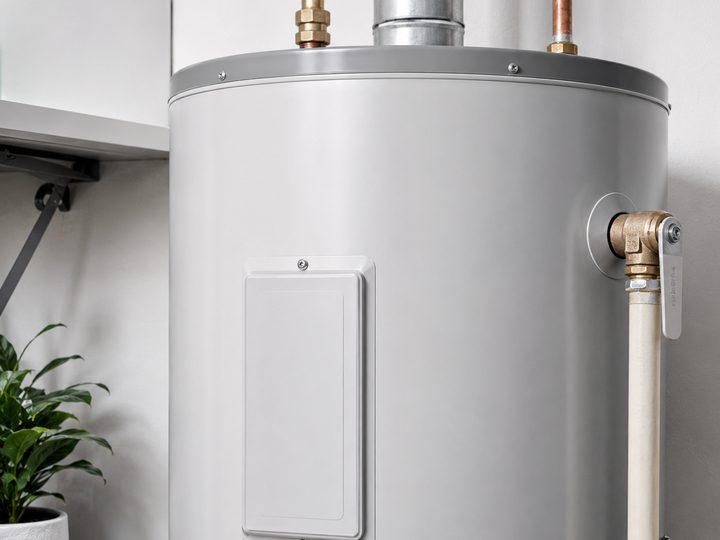
Repair, replacement and new installation for tank and tankless water heaters, with same-day service on most failures.
Short answer
Most water heater problems come down to one of four things: a failed heating element or thermostat on an electric unit, a pilot or thermocouple fault on a gas unit, sediment build-up in the tank, or a tank that has simply reached the end of its life. The first three are repairs. The fourth is a replacement, and it is usually obvious because the tank is leaking.
Signs your water heater is failing
A water heater rarely fails without warning. It gives you weeks of small signals first, and catching them is the difference between a scheduled replacement and a flooded utility room.
Water that runs lukewarm or runs out early. Usually a failed element on an electric unit, or sediment taking up space that should hold hot water.
Rumbling or popping while it heats. That is sediment on the bottom of the tank, boiling water trapped underneath it.
Rusty or metallic-tasting hot water. The tank lining or the anode rod has gone, and once the lining goes the tank is on borrowed time.
Water pooling around the base. A leaking tank cannot be repaired. Shut off the supply and call us.
The unit is over ten years old. Most tank heaters last eight to twelve years. Past that, replacing on your schedule beats replacing on its schedule.
A leaking tank is the one symptom that is never a repair. Everything else is usually fixable.
Tank or tankless
This is the question most people ask, and the honest answer is that it depends on how your household uses hot water rather than on which technology is better.
A tank unit suits you if
You want the lowest up-front cost, your hot water demand is predictable, and you have somewhere to put a unit that holds forty to eighty gallons. Installation is simpler, which keeps the total cost down.
A tankless unit suits you if
You want endless hot water, you are tired of running out when several people shower back to back, or you want the space back. They cost more to install, particularly if the gas line or venting needs upgrading, and they last considerably longer.
We will tell you which one actually fits your house rather than which one has the bigger ticket. If the answer is a straight tank swap, that is what we will quote.
What we service
Gas and electric tank water heaters, repair and replacement
Tankless and on-demand systems, including descaling and maintenance
Thermostats, heating elements, thermocouples and gas control valves
Anode rod replacement to extend tank life
Sediment flushing and annual maintenance
Expansion tanks, T&P valves and venting corrections
Financing on replacements
A water heater almost never fails at a convenient moment. If yours has gone and a replacement is not something you planned for this month, we offer financing on new installations, and you can apply online before we come out.
Common questions
How long does a water heater last?
Eight to twelve years for a typical tank unit, and fifteen to twenty for a well-maintained tankless system. Water hardness matters more than most people expect, and annual flushing genuinely extends the life of both.
Can you replace a water heater the same day?
Usually yes on a like-for-like tank swap, provided we have the size in stock. Tankless installations and anything that needs gas or venting work are normally scheduled, because doing them properly takes longer than an afternoon.
Why does my hot water run out so quickly?
Either the tank is undersized for how the household actually uses hot water, a heating element has failed so only part of the tank is heating, or sediment is occupying volume that should hold water. All three are worth diagnosing before you assume you need a bigger unit.
Is it worth flushing a water heater?
Yes, and it is one of the cheapest things you can do for it. Sediment insulates the bottom of the tank from the burner, which wastes energy and overheats the steel above it.
No hot water?
Tell us the symptom and the age of the unit and we can usually narrow it down over the phone.
A system that quits without warning leaves you guessing at both the cause and the bill, and most people find out the price only after the work is done. We diagnose the fault, show you what we found, and agree the cost with you before anything is touched. Call (417) 241-5687 or book online.