
(417) 241-5687 24/7 Emergency Service
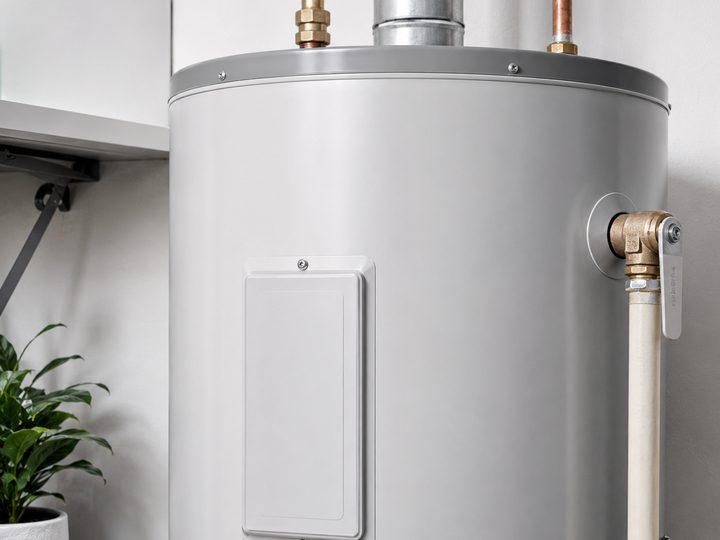
Swapping a tank for a tankless unit is not a like-for-like replacement, and the quotes people find surprising are usually the ones being honest about that.
A tank heats water slowly and stores it. A tankless system heats water only when a tap opens, which means it has to move a great deal of energy in a very short time. That single difference drives everything else about the install.
On a gas tankless unit, the gas supply is the first question. A tank might draw 40,000 BTU; a whole-home tankless gas water heater can call for 180,000 or more. Existing gas line sizing frequently cannot deliver that, so to install a tankless properly you often have to upgrade your gas line back to the meter. Skipping it gives you a unit that cannot reach its rated output and short cycles trying.
Venting is the second. Condensing units need sealed stainless or PVC exhaust, not the old atmospheric flue the tank used, and the termination has to meet local codes for clearance from windows and doors.
Then the water line connections, isolation valves for future flushing, condensate drainage on a condensing unit, and gas pressure verified under load rather than at rest. Turn on the gas without checking the pressure while the unit fires and you have a system that works until two showers run at once.
An electric tankless has no venting and no gas work, but the electrical demand is severe, often multiple dedicated circuits and sometimes a panel that cannot support it. That is the version people buy from a big-box store like Home Depot and then discover the real cost of.
Endless hot water is the reason most people ask, and it is real. A tankless unit will heat water as long as a tap is open, so back-to-back showers stop being a scheduling problem.
The efficiency argument is also real but smaller than the marketing suggests. A tank loses heat continuously keeping stored water hot, and a tankless system has no standby loss, which shows up as a modest monthly saving rather than a dramatic one.
Lifespan is the strongest argument. A tank runs eight to twelve years. A well-installed and maintained tankless unit runs twenty or more, with replaceable parts rather than a rusting tank at the center of it.
Where it is not worth it: a small household with modest hot water use, a house where the gas line upgrade is expensive, or a tank that failed today and needs replacing this afternoon. In those cases a good conventional tank unit is the honest recommendation.
This is the part that decides whether you get twenty years or eight.
Hard water leaves scale on the heat exchanger, and because a tankless system heats water so intensely, scale builds faster there than in a tank. Left alone it insulates the exchanger, the unit works harder for less, and eventually it throws an error and stops.
The fix is an annual descale, circulating a descaling solution through the heat exchanger for about an hour. If isolation valves were fitted at installation it is straightforward. If they were not, it means cutting them in first, which is one more reason installation quality matters.
Warning signs between services: water that runs hot then cool then hot again, a drop in flow at the hot tap, or an error code on the display. All three usually mean scale rather than failure, and all three are cheaper to deal with early.
Descaling sits alongside the heating and cooling equipment on a maintenance plan, which is the simplest way to make sure it actually happens each year.
Knowing the order makes it obvious why the quote looks the way it does.
First the old water heater is drained, disconnected and removed, and the space it occupied is usually reclaimed, since a wall-mounted tankless unit frees up the floor a tank was standing on.
Then the water supply line and the return are rerouted to the new location and isolation valves are fitted so the unit can be descaled later without cutting anything. A pressure relief valve is fitted, and on a closed system an expansion tank goes in to absorb the pressure rise when the water heats, which local codes require and which is one of the more common things missing on a bad install.
On a gas model, the gas line is sized and run, and natural gas pressure is verified while the unit fires at full rate rather than at rest. Then the exhaust is run and terminated to the clearances the code sets.
Finally the unit is commissioned: temperature set, flow tested at more than one hot water faucet at once, and the installation instructions and registration handed over rather than left in the box. A plumber who skips the two-fixture test has not proved the thing you bought it for.
Most tankless faults are the igniter, the flow sensor, the flame rod or scale, and all four are repairs rather than replacements. A tankless unit is built to have parts changed, which is the advantage over a tank where a leak means the whole thing goes.
If the fault turns out to be gas supply or a water line rather than the unit itself, that is a job for licensed plumbing work and we handle both, so it does not become two companies pointing at each other.
Redeemed HVAC & Plumbing Heating, Cooling, Duct Cleaning, and Plumbing offers the broadest array of tankless water heating systems in the greater 417 area.
State condensing tankless water heaters are compact heating units that provide hot water as it is needed, and do not store hot water like traditional tank-type water heaters.
When a hot water tap is turned on, water enters the tankless water heater. A sensor detects the water flow, and activates a gas heating device, which quickly raises the water temperature to a preset level. When water flow stops, the heating device shuts off. Thermostatically-controlled tankless water heaters vary their output temperature according to water flow rate and inlet water temperature.
Unlike traditional storage tank water heaters, tankless water heaters do not store a reservoir of hot water. As a result, standby losses are reduced, which makes them an energy-efficient alternative to traditional water heating.
Because tankless heaters do not store water, they are less subject to corrosion than tank-type heaters. As a result, their expected equipment life is longer – possibly more than 20 years, compared with 10 – 15 years for traditional heaters. Also, because they are not heating 40 – 50 gallons of water 24 hours a day, tankless water heaters are less susceptible to leakage than tank-type water heaters.
Improve your home’s indoor air quality by ensuring your air ducts and dryer vents are clear of debris, pollutants, and pests.(417) 241-5687
Open 24 hours, 7 days a week, including holidays.
Two tune-ups a year on every system you own, 10% off all repairs and priority scheduling, from $14 a month.
Approved financing spreads the cost of a replacement, so the timing of the work is your decision rather than the equipment’s.
A system that quits without warning leaves you guessing at both the cause and the bill, and most people find out the price only after the work is done. We diagnose the fault, show you what we found, and agree the cost with you before anything is touched. Call (417) 241-5687 or book online.