
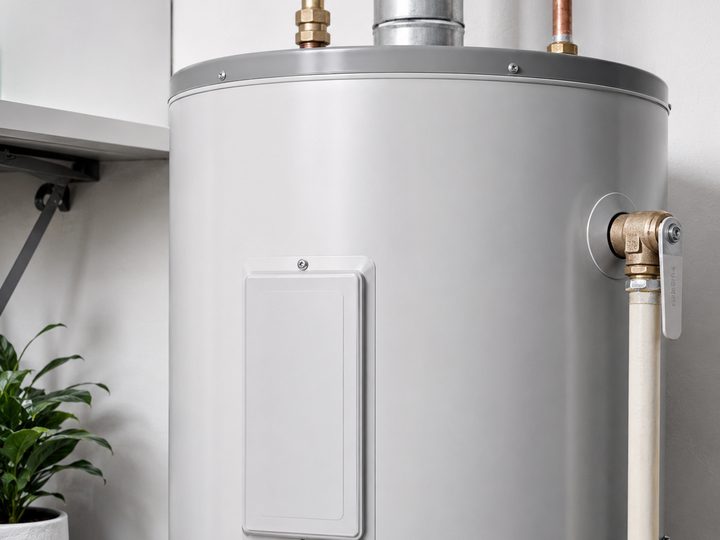
The standard advice is to replace a water heater at about ten years. It is not wrong, and it is the wrong reason.
A tank water heater in this part of Missouri rarely fails because the steel got old. It fails because of what collected inside it, and age is only a proxy for how long it has been collecting. That is why two identical heaters installed the same week in the same neighborhood can be years apart in condition, and why one household gets fifteen years and another gets eight.
Once you know the mechanism, the repair-or-replace decision gets much clearer. For water heater work in Nixa call (417) 356-4048.
Repair it when the fault is a component: a thermostat, a heating element, a gas control valve, a thermocouple, an anode rod, a temperature and pressure relief valve, or a broken dip tube. All of those are replaceable parts and none of them means the heater is finished. Replace it when the tank itself is leaking, because there is no repair for a perforated tank, and the leak will not improve. In between sit the judgment calls: a heater well past ten years needing a significant part, a heater that has already had two repairs, or a household that has outgrown the capacity it has. The single question that settles most cases is where the water is coming from. Water at the fittings or the relief valve is a repair. Water weeping from the body of the tank is a replacement.
Repair:
Replace:
This is the part that explains the local pattern.
Groundwater across southwest Missouri moves through limestone and dolomite, which dissolves calcium and magnesium into the water. That is what hard water is, and it is a function of the geology rather than anything a utility is doing wrong.
Inside a tank water heater, those dissolved minerals come out of solution when the water is heated, and they settle at the bottom of the tank. On a gas heater that is precisely where the burner is. So a layer builds between the flame and the water it is meant to heat, and the layer insulates.
Three things follow from that, in order:
On an electric heater the mechanism is slightly different: sediment buries the lower element, which then burns out early. Same cause, different failure.
From there the sequence is predictable. Shorter hot showers, a louder heater, an anode rod consumed faster than it should be, and eventually the tank itself.
Three things, in order of how much difference they make.
Flushing the tank. Draining several gallons from the bottom drain valve periodically pulls out loose sediment before it compacts. It is most effective when done regularly from early in the heater’s life, and much less effective once a hard layer has formed, which is the main argument for not waiting.
The anode rod. A sacrificial metal rod inside the tank corrodes on purpose so the tank lining does not. Once it is consumed, the tank starts taking the corrosion. Checking and replacing an anode rod is cheap, unglamorous and the single most effective thing anyone does to extend a tank’s life. It is also the maintenance item most often skipped entirely.
Water treatment. Reducing hardness upstream of the heater addresses the cause rather than the symptom, and it helps fixtures, faucets and appliances at the same time. Water treatment systems are available, and whether one makes sense depends on your water and your household.
Worth understanding before a replacement decision, and worth being honest about in a hard water region.
A tank heater stores hot water and reheats it. Its limits are capacity and standby loss. Its strength is simplicity, and it tolerates hard water by letting sediment fall harmlessly to the bottom until it does not.
A tankless heater heats water on demand through a heat exchanger. It never runs out, and it does not store water. Its weakness in this region is specific: hard water scales the heat exchanger, which is a narrow passage rather than a large tank bottom, so scale affects performance sooner and descaling becomes a scheduled maintenance task rather than an optional one. Tankless units are a good choice here, and they are a better choice alongside water treatment.
Capacity is the other half of the decision. A household that runs out of hot water with back-to-back showers has either an undersized tank or a sediment problem that is behaving like one, and those two get confused constantly. Finding out which costs one visit.
How long should a water heater last?
Longer with maintenance than without, and the spread is wide. The anode rod and regular flushing make more difference than the brand does.
My hot water runs out faster than it used to. Do I need a bigger tank?
Maybe, but check sediment and the dip tube first. Both reduce the usable hot water in a tank that is physically the same size it always was, and both are cheaper than a bigger heater.
Is the popping noise dangerous?
No. It is water boiling under a sediment layer. It is a maintenance signal rather than a safety one. A relief valve discharging is the safety signal.
Can I flush it myself?
Yes, carefully, with the power or gas off and attention to the fact that the water is scalding. If the drain valve is old and plastic it can fail to reseal, which is worth knowing before you open it.
Will a water softener fix a heater that is already full of sediment?
It stops the problem getting worse and does not undo what is there. Treating water early helps a new heater far more than it rescues an old one. Related plumbing work is on the Nixa water heater services page.
Do you handle the heating and cooling side too, or only plumbing?
Both. The same company covers HVAC system work and plumbing, so a water heater visit and a furnace visit at the same Nixa address are one relationship.
Is a tankless water heater worth it in hard water?
It is a good option paired with water treatment, and a worse one without it, because scale reaches a narrow heat exchanger faster than it reaches a tank bottom. Descaling becomes scheduled maintenance rather than optional.
Can you fit a water softener at the same time as a new heater?
Water treatment systems are a listed service, and fitting one while the heater is being replaced is the sensible order, because the new tank then starts clean. Call (417) 356-4048.
The decision usually comes down to one observation, which is where the water is coming from, and one piece of history, which is whether the tank has ever been flushed or the anode replaced. Both take minutes to establish.
Redeemed HVAC & Plumbing handles water heater repair, water heater installation, tank and tankless systems and water treatment, offers financing, and runs emergency service 24 hours. Call (417) 356-4048.
Water heaters sit alongside the rest of the plumbing, and hard water affects all of it. These pages cover the related work, from leaks and pipe repair to the fixtures that scale up fastest in this region.
Redeemed HVAC & Plumbing is an air conditioning repair service in Nixa, and the same team handles the heating side, the ductwork and the plumbing. A technician arriving for an AC repair can look at the furnace, the HVAC system as a whole, the thermostat and indoor air quality on the same visit, which is usually worth more to a homeowner than booking three separate calls.
Emergency HVAC service runs 24 hours. Call (417) 356-4048.
(417) 356-4048
Open 24 hours, 7 days a week, including holidays.
Two tune-ups a year on every system you own, 10% off all repairs and priority scheduling, from $14 a month.
Approved financing spreads the cost of a replacement, so the timing of the work is your decision rather than the equipment’s.
A plumbing problem leaves you guessing at both the cause and the price. The diagnosis comes with the readings behind it and the quote comes in writing, itemized, before any work starts. Call (417) 356-4048.